
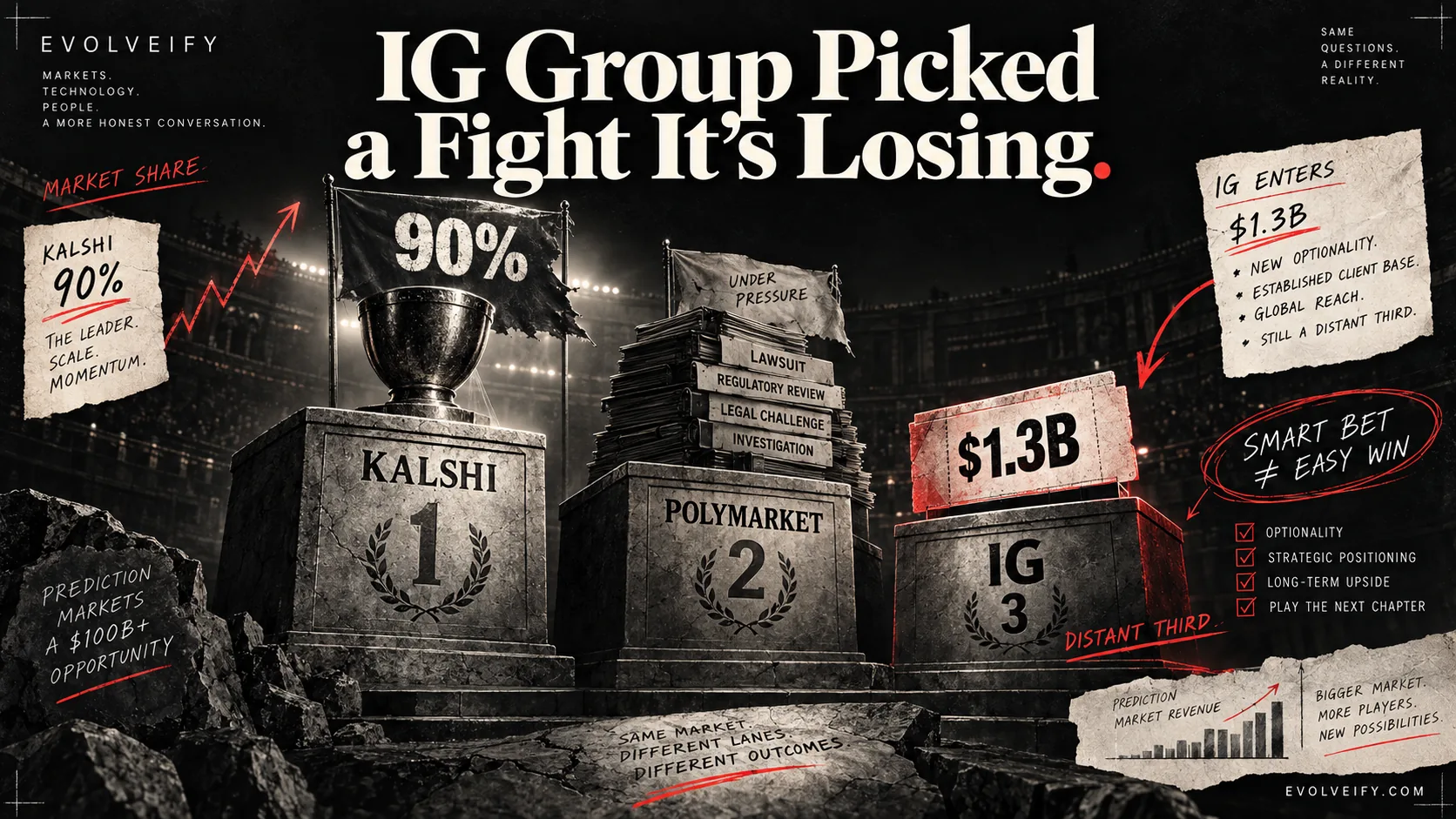
The numbers first. Kalshi did $21.1 billion in volume in June alone and controls roughly 90% of US prediction market activity, on a trajectory toward a targeted $40 billion valuation after already hitting $22 billion in April. Polymarket, the other name everyone says in the same breath, did $9.7 billion globally in June and just spent $112 million buying the CFTC-licensed exchange QCX to build a real US-regulated arm, Polymarket US, and is now pushing the CFTC to let its main offshore exchange serve US users directly too. Underdog, IG's new $1.3 billion acquisition, is the third-largest US prediction markets venue by regulated volume. Third, a distant third, behind Kalshi and Robinhood.
So when IG writes a $1.3 billion check for the number three player in a market where number one holds 90% share, that's not "entering the category." That's picking a fight it's currently losing and betting its balance sheet can close the gap.
Here's why that's a more interesting story than "market expands, gets regulated, everyone wins." IG is buying in at the exact moment the two biggest names are fighting each other, not settling into a stable order. Polymarket spent nine figures just to get a CFTC-regulated foothold back after nearly three years locked out of the US, and it's still lobbying to bring its main exchange home while a fresh CFTC probe opened in June. Kalshi is raising billions specifically to entrench the lead it already has. IG isn't stepping into a mature market with a clear third slot open. It's stepping into an active land grab where the top two are still spending to win, and betting that scale, distribution, and a functioning compliance operation beat being first.
That's the real signal, and it's a sharper one than "regulation is coming." IG has spent decades building the retail trading infrastructure, licensing relationships, and risk management that a fast-moving native like Polymarket had to buy its way into after getting burned by US regulators once already. IG isn't hoping the rules get friendlier. It's betting that when the rules do get sorted, whoever already has bank-grade compliance wins the flow that Kalshi and Polymarket are currently fighting over with lawsuits and valuation rounds.
Buying the distant third place in a 90%-controlled market only makes sense if you don't believe the current market share is permanent. IG just put $1.3 billion behind the bet that Kalshi's dominance is a head start, not a moat, and that Polymarket's regulatory scars make it slower to scale than a broker who has done this across dozens of regulated markets already.
Kalshi has the volume. Polymarket has the brand and the lawsuits. IG just bought the balance sheet to outlast both, so which one actually wins when the regulatory dust settles: the incumbent with 90% share, or the operator who's spent decades building exactly the compliance muscle this fight will come down to?
Observed
What changed
$1.3B buys you a distant third place behind Kalshi's 90% and Polymarket's lawsuits — here's why that's the smart bet, not the desperate one.
Method
How this record was read
- Why now · editorial reading
- Filed 31 Jul 2026 · Signal desk · 3 min read. This is when the desk judged the move worth writing up — the dispatch body carries the reasoning.
- The tactic worth testing · editorial reading
- No tactic is claimed here unless the dispatch states one.
- Open question · editorial reading
- Does this hold as Signal distribution keeps moving, or is it specific to this cycle?