
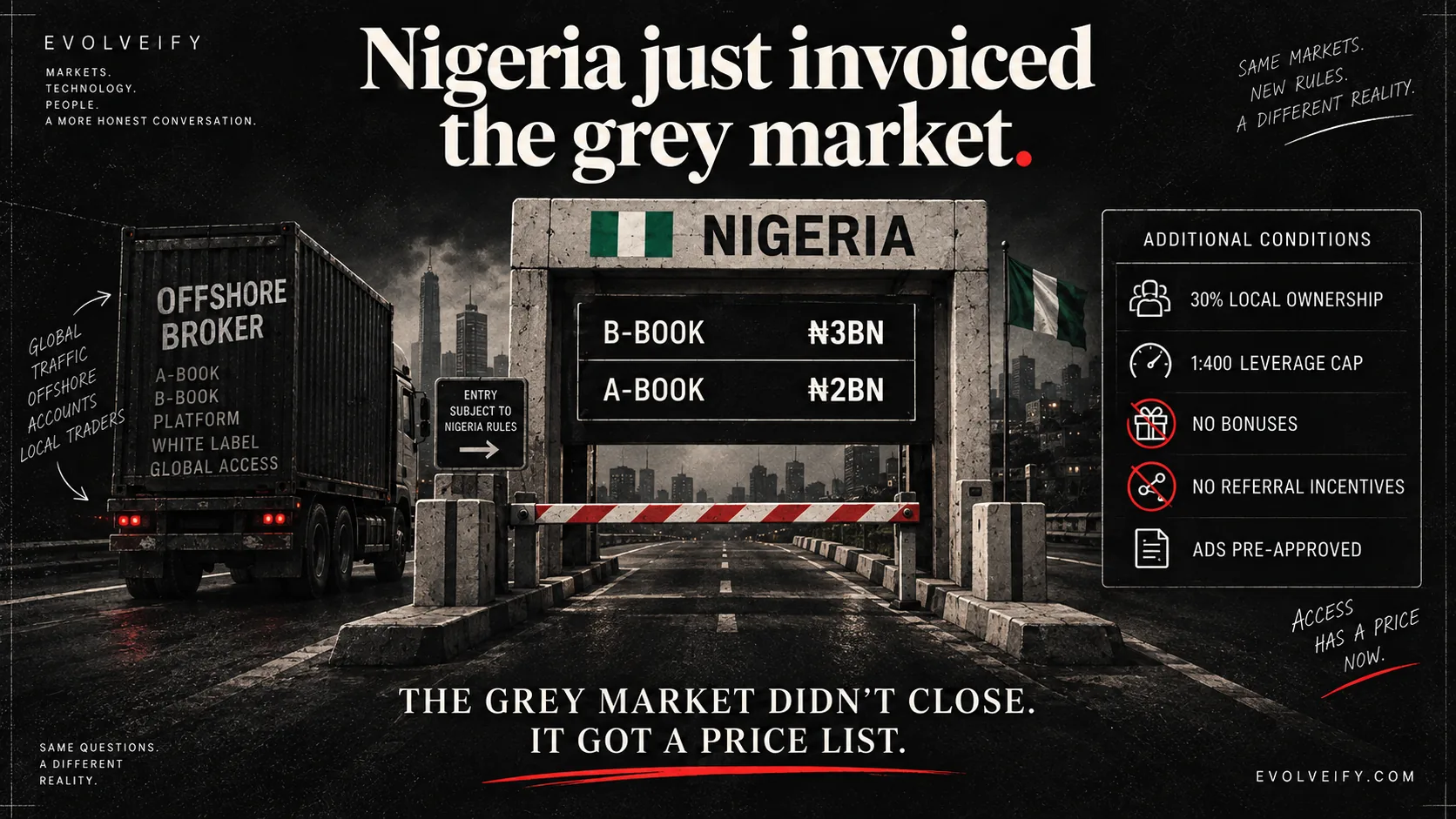
Nigeria just put every offshore broker on notice. Not with a warning. With a rulebook.
On September 1, SEC Nigeria published draft Rules on Online Forex Trading and CFDs under the Investments and Securities Act 2025. Read the perimeter clause first. A foreign broker falls under Nigerian supervision if it lists Nigeria as a supported country, opens accounts for Nigerians, or markets to them through local affiliates or influencers. That last line is aimed at your channel.
The numbers: N3 billion paid up capital for a B-book broker, about $2.3 million. N2 billion for A-book, $1.5 million. N5 billion for a platform provider, $3.8 million. Corporate IBs need N150 million, roughly $113,000. Individual IBs N30 million, $23,000. Thirty percent of the broker must be owned by Nigerian citizens who sit on the board, no nominees, no trusts. Leverage capped at 1:400 on majors. Bonuses, trading contests and referral incentives banned. Every advert and every influencer post filed with the SEC for approval. Monthly disclosure of how many retail accounts lose.
Three months to apply once the rules bite. Six to comply. Miss it and you cease.
Here's why this matters beyond Lagos.
First, the grey market playbook has an expiry date. For fifteen years the model was simple: hold a CySEC or FSCA license for the brand, onboard Africa, Asia and LATAM through an offshore entity, pay IBs whatever it takes. It worked because nobody local was writing rules. SEC DG Emomotimi Agama said it plainly: an unregistered platform is illegal. Kenya's CMA already licenses online forex brokers. South Africa's FSCA has its ODP regime. Nigeria was the biggest hole left in Africa. It's closing.
Second, regulators copy each other. ESMA capped leverage in 2018 and within a few years ASIC, CySEC and the FSCA had matched it. Nigeria's draft reads like ESMA rewritten for a frontier market, plus a local ownership rule Europe never needed. Vietnam, Pakistan, the Philippines and Egypt are watching how many brokers apply. I've built partner networks in two of those markets. Once one big market proves offshore brokers will pay for access, the next five write the same rule.
Third, the affiliate channel is where enforcement lands first. A regulator can't easily reach a St Vincent entity. It can reach the Lagos influencer, the local IB with a WhatsApp group, the payment agent. Referral incentives banned means your IB commission structure is now a compliance document. Filing every influencer promo for approval means your creative pipeline just got a regulator sitting in it.
What this means: if your acquisition plan for the next 18 months has "emerging markets" as the volume line, that line now carries a licensing cost, a local partner and a leverage cap. Budget for it, or watch the brokers who do take the market from you.
The grey market isn't dying. It's being invoiced.
So which is cheaper: $2.3 million and a Nigerian director, or losing Nigeria entirely to the broker who paid it?
Observed
What changed
$2.3 million, a Nigerian director, and a ban on referral incentives. Every other frontier market is reading the same PDF.
Method
How this record was read
- Why now · editorial reading
- Filed 04 Sep 2026 · Signal desk · 3 min read. This is when the desk judged the move worth writing up — the dispatch body carries the reasoning.
- The tactic worth testing · editorial reading
- No tactic is claimed here unless the dispatch states one.
- Open question · editorial reading
- Does this hold as Signal distribution keeps moving, or is it specific to this cycle?