
Every affiliate manager I talk to right now is doing the same thing. Building an AI outreach sequence. Automating the DMs. Scaling the "touches per week" number and calling it a growth strategy.
Nobody's automating the fraud check. That's backwards.
I've spent 13 years inside CFD affiliate programs. I've seen what actually kills a program, and it's never "we didn't message enough partners." It's the one bad affiliate nobody caught for four months, running incentivized traffic through a cookie stuffed link, until compliance finds it during a licensing review and now everyone's explaining themselves to CySEC.
You don't get fined for slow outreach. You get fined for the partner you never should have onboarded.
And the fraud isn't rare. Every unmonitored regulated affiliate program I've audited has had it: cookie stuffing, incentivized traffic dressed up as organic, sub affiliate networks nobody approved. Same signature every time. A partner who sounds airtight on the onboarding call, and numbers that only hold up as long as nobody pulls the raw clicks instead of the summary they sent you. That's not a rounding error. That's real margin walking out the door to someone running fake leads through a VPN farm while your outreach bot congratulates itself on "engagement rate."
Here's the tactic. The audit you should run this week.
Most brokers, exchanges, and iGaming operators are sitting on an affiliate roster nobody has looked at since onboarding. Not glanced at. Looked at. Here's the version you can run in an afternoon, no new headcount, no six figure fraud tool.
Pull your top 50 affiliates by volume, sorted by conversion to deposit ratio. Anything converting suspiciously high, above 40 to 50% depending on your vertical, gets flagged first. Real traffic doesn't convert that clean. Fraud does.
Cross reference IP and device clustering on your top 10 flagged accounts. If you're on Adjust, AppsFlyer, or Branch, this data already exists. It's just never pulled into one view. Feed it into a basic AI classifier (even a GPT prompt with the raw CSV works as a first pass) and ask it to surface clustering anomalies. You'll find the same 30 devices generating "unique" leads for three different sub affiliates.
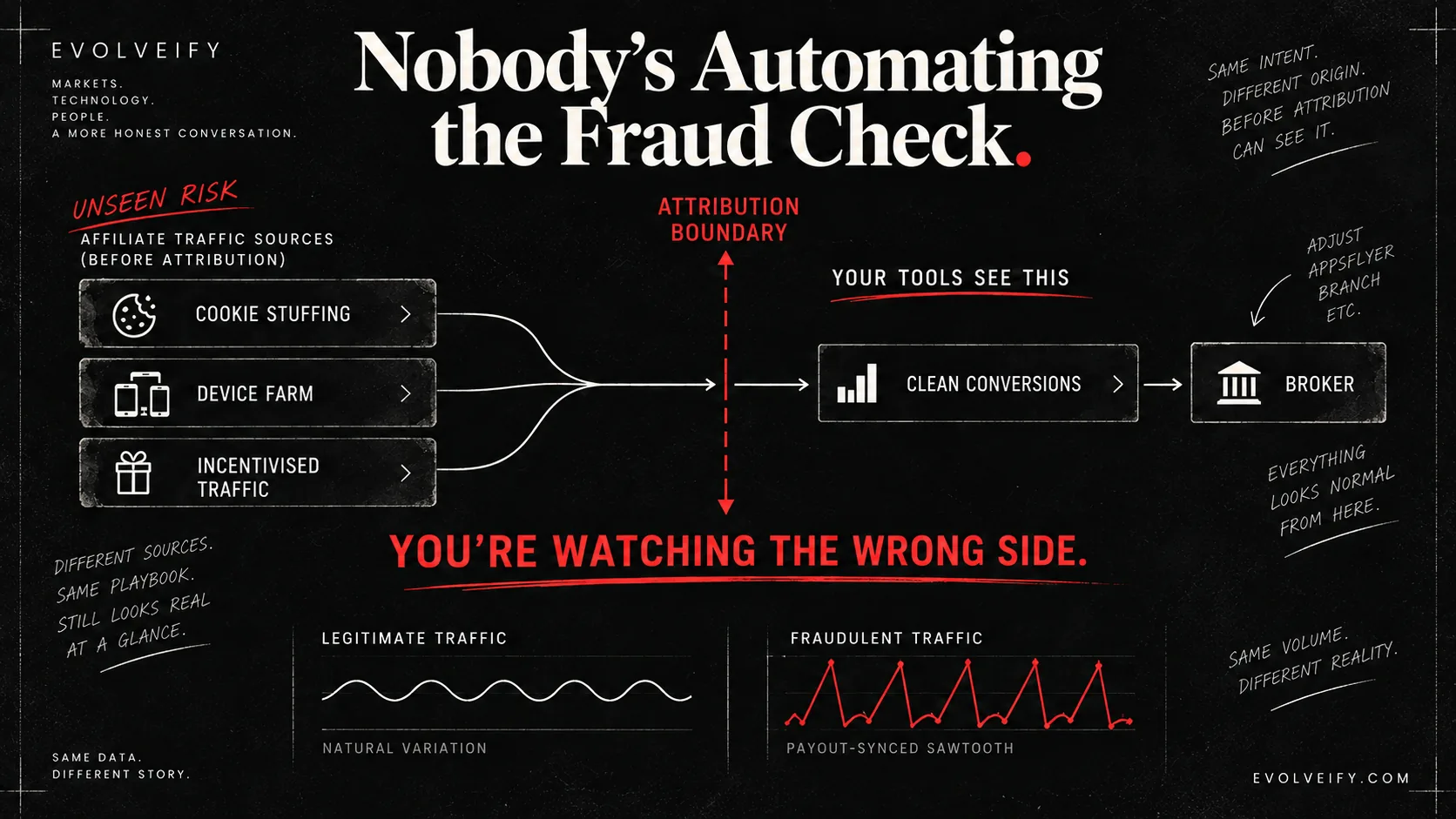
Check payout timing against activity timing. Fraudulent affiliates front load activity right before payout cycles and go quiet after. Legitimate partners have noise. Ups, downs, seasonality. A clean sawtooth pattern synced to your payment schedule is a person who knows exactly when you're looking.
That's it. Three pulls, one afternoon, and you'll find the 2 to 3 accounts that are quietly costing you more than your entire outreach automation saved you this quarter.
The trap: don't just kill the flagged accounts and move on. Document why each one got flagged, in plain language, dated, filed. That documentation is the difference between "we caught it" and "prove you caught it" when a regulator asks. And one of those conversations takes five minutes.
Here's the part almost nobody running mobile affiliation wants to hear. Most teams think Adjust or AppsFlyer fraud protection has them covered. It catches the obvious stuff: device ID resets, install hijacking, click flooding. Cookie stuffing isn't on that list. Neither is a properly rotated device farm. Both happen before attribution, and MMP fraud suites are built to flag things after attribution, once the damage is already sitting in your numbers.
That's why cookie stuffing survives longer than almost any other fraud type in this industry. You don't catch it with a dashboard toggle. You catch it by pulling raw click data and looking for the signature: cookies set with no click behind them, timestamps clustering in patterns no real session produces. That's analysis, not a setting.
Proper mobile affiliation needs two things. An experienced Adjust or AppsFlyer technical hire who understands the SDK and the raw data, not someone reading a dashboard and calling it monitoring. And your own anti-fraud layer sitting in front of attribution, not the MMP's suite as your only defense. Both cost time and money. Neither kills fraud completely, it adapts as fast as you patch it, but together they cut your exposure hard instead of leaving the top of funnel wide open.
Now here's the take, and I'll say it the way I'd say it to your face.
Regulated affiliate programs are optimizing the wrong 20%. Everyone's AI budget went to acquisition velocity. More outreach, faster replies, bigger top of funnel. Almost none of it went to program integrity. That's exhausting to watch, because it's the same mistake every time.
Three reasons this keeps happening.
First, outreach automation is visible and fraud prevention isn't. A dashboard showing "1,200 touches this month" looks like progress in a Monday leadership meeting. A fraud audit that finds nothing wrong looks like nothing happened. Leadership funds what's visible, not what's protective. The budget follows the demo, not the risk.
Second, nobody wants to own the bad news. If you build the audit and it finds three fraudulent affiliates you personally onboarded, that's a hard conversation with your own name on it. Easier to keep adding new affiliates than to go back and clean the ones you already have. I get it. I've had that conversation. It's still the wrong call.
Third, the regulators are getting sharper faster than the industry is getting cleaner. MGA, CySEC, and the UKGC have all tightened affiliate oversight language in licensing reviews over the past two years. They're explicitly asking operators to demonstrate ongoing affiliate due diligence now, not just at onboarding. Most compliance teams still treat that as a paperwork exercise. It isn't anymore. It's becoming the actual test.
Think about the last time a broker or an operator made headlines for this. It's never framed as "acquisition team underperformed." It's framed as "undisclosed affiliate relationships," "unlicensed introducing brokers," "failure to monitor third party marketing." It's affiliate language. Every time.
I built a version of this fraud scoring workflow for a broker last year. Not a full platform, just the audit logic running as automated agents instead of a quarterly spreadsheet review. Took under two months to catch what a manual review had missed for two years. More on where that's going soon.
The uncomfortable part: compliance has always been framed as the department that slows growth down. Cost center. Friction. The thing sales complains about in every quarterly review.
Flip that. The operators who treat affiliate integrity as infrastructure, not a checkbox, are the ones who'll survive the next enforcement cycle while their competitors are explaining a suspended license to their board. Compliance isn't the tax on growth. It's the only kind of growth that doesn't get clawed back.
One of those gets you a growth chart for the board deck. The other one keeps you in business long enough to present it.
So ask yourself the actual question before you greenlight another outreach automation project this quarter. Are you building a bigger funnel, or are you building a funnel you can defend when a regulator asks you to prove every partner in it is real?
Observed
What changed
Adjust and AppsFlyer catch the obvious stuff. Cookie stuffing isn't on that list, and regulators just made it your problem.
Method
How this record was read
- Why now · editorial reading
- Filed 14 Aug 2026 · Signal desk · 6 min read. This is when the desk judged the move worth writing up — the dispatch body carries the reasoning.
- The tactic worth testing · editorial reading
- No tactic is claimed here unless the dispatch states one.
- Open question · editorial reading
- Does this hold as Signal distribution keeps moving, or is it specific to this cycle?