
Skip to content
Back to the ledger
Affiliate Economics27 JUL 20263 min readWATCHNeeds a call

The $497,000 Funeral

BitMEX and BitMart died three days apart last week. Your revshare book is the real casualty.

Author observation — Evolveify original research.

How counterparty risk climbsAuthor observation.

Counterparty risk, rung by rung — closure announced, trading restricted, token value collapses, revshare dries up, and concentration becomes a portfolio problem

  1. Rung 01 · Closure

    The venue announces its own funeral

    Two mid-tier crypto exchanges announced closures three days apart — one after eleven years, the other opening an “orderly wind-down” after nine.

  2. Rung 02 · Restriction

    Activity is closed off or forced shut

    New registrations, deposits, and trading stopped the same day at one venue, with trading ending August 26 and the platform fully dark January 31, 2027. The other moved to reduce-only trading a month ahead and will force-close every open position at 04:00 UTC on September 23.

  3. Rung 03 · Asset collapse

    The token holders pay first

    BMEX fell over 90%, leaving a market cap around $497,000 — a pioneer priced like a parked domain. BMX cratered roughly 60% on the news.

  4. Rung 04 · Revenue

    The “lifetime” revshare dies with the venue

    Every affiliate who took exchange tokens instead of cash, and every partner on a lifetime revshare deal, watched the asset behind the payout evaporate. The CPA dries up; the tail revenue goes to zero.

  5. Rung 05 · Concentration

    It stops being a trader problem

    A revshare book is only as alive as the exchange paying it. The move the record states: diversify across venues that will still exist in January 2027, weight toward the regulated names, take cash over tokens every time, and cap how much of the book any single counterparty can represent.

Stated in the record — BMEX down over 90%, market cap around $497,000; BMX down roughly 60%; daily volume collapsed to roughly $400,000, under 0.01% of the market; wind-down completes January 31, 2027.

Counterparty risk in five rungs, following the sequence the record observed across two mid-tier crypto exchange closures announced three days apart. First, the venue announces its own closure — one after eleven years, the other beginning an orderly wind-down after nine. Second, activity is restricted or forced toward closure: new registrations, deposits, and trading stopped the same day at one venue, with trading ending August 26 and the platform going fully dark January 31, 2027; the other set reduce-only trading a month ahead and will force-close every open position at 04:00 UTC on September 23. Third, the token collapses around the closure: BMEX fell over 90 percent, leaving a market cap around $497,000, and BMX cratered roughly 60 percent on the news. Fourth, affiliate revenue attached to the venue dries up: every partner sitting on a lifetime revshare deal watched the asset behind the payout evaporate — the trader loses a position, the affiliate loses the annuity, and the tail revenue goes to zero. Fifth, concentration becomes a portfolio problem: a revshare book is only as alive as the exchange paying it, and cheap, generous mid-tier terms were generous for a reason. The record's move: diversify across venues that will still exist in January 2027, weight toward the regulated names, take cash over tokens, and cap how much of the book any single counterparty can represent.

Two crypto exchanges announced their own funerals last week. Three days apart. If you run acquisition in this space, that's not a headline , it's a warning shot.

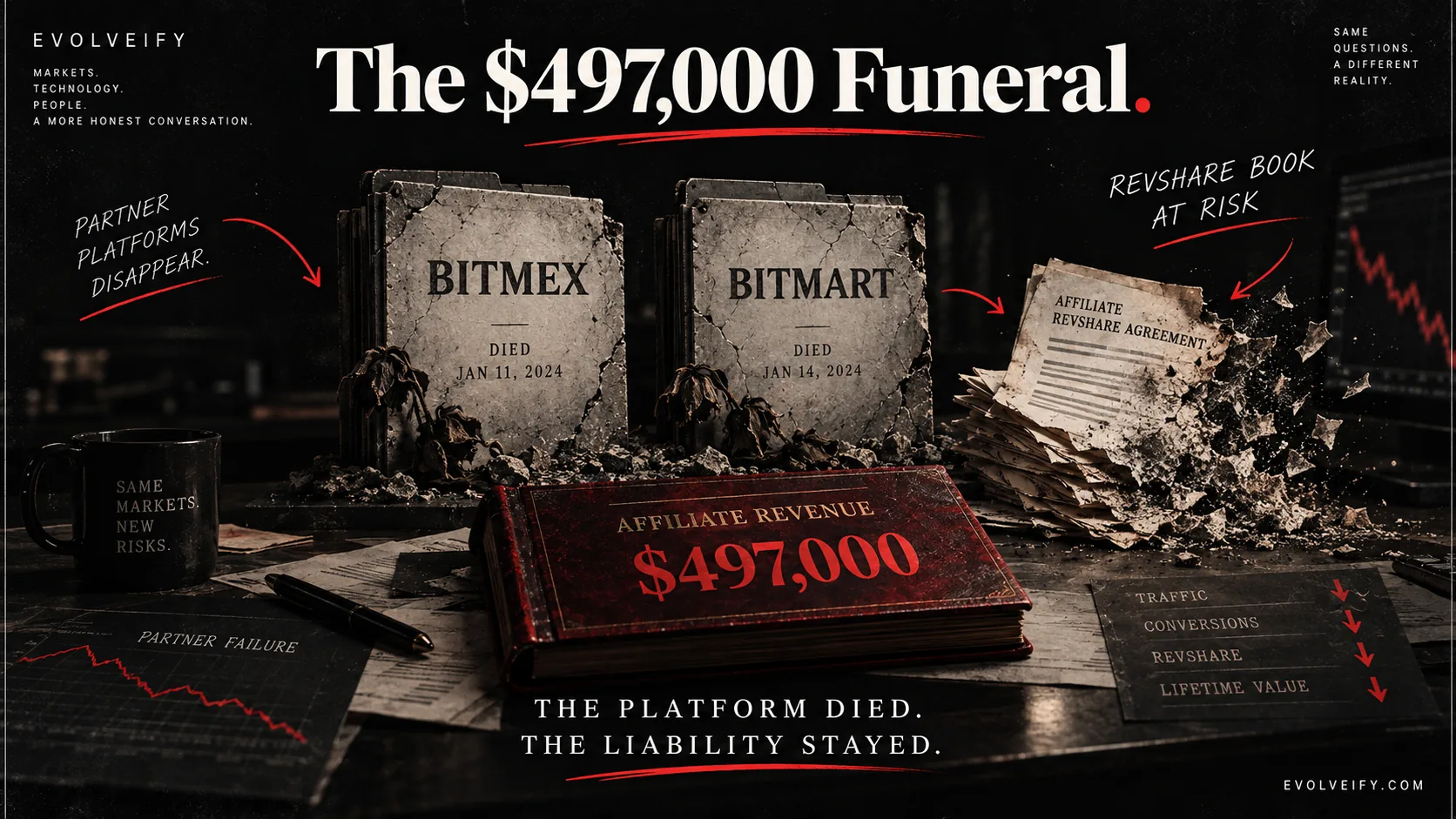
1. BitMEX is dead. On July 23, HDR Global Trading pulled the plug on the exchange that invented the perpetual swap. Eleven years. The venue that once was crypto derivatives will force-close every open position at 04:00 UTC on September 23, with reduce-only trading kicking in a month before. The tell was in the numbers: daily volume had collapsed to roughly $400,000 — less than 0.01% of the market. The BMEX token fell over 90%, leaving a market cap around $497,000. A pioneer, priced like a parked domain. "Strategic review," the statement called it. That's the polite word for the math not working anymore.

2. BitMart followed 72 hours later. On July 26, nine years in, BitMart began an "orderly wind-down." New registrations, deposits, and trading stopped that day. Trading ends August 26; the platform goes fully dark January 31, 2027. The BMX token cratered roughly 60% on the news. Two mid-tier venues announcing closures in the same week isn't a coincidence. It's the mid-tier model hitting the wall in public , squeezed between the top-five giants above and the leaner regulated players below, with nowhere left to sit.

3. The token holders paid first. BMEX down 90-plus, BMX down 60 , in days. Every affiliate who took exchange-token bonuses instead of cash, every partner sitting on a "lifetime revshare" deal with a mid-tier venue, just watched the asset behind their payout evaporate. The trader loses a position. The affiliate loses the annuity.

Here's the part nobody in our world says out loud: counterparty risk isn't just a trader's problem. It's a growth problem. For thirteen years the affiliate game treated revshare as the smart, passive money , sign the deal, stack the lifetime value, coast. But a revshare book is only as alive as the exchange paying it. When BitMEX and BitMart die, so does every "lifetime" attached to them. The CPA dries up. The tail revenue goes to zero. And the acquisition lead who concentrated their book on cheap, generous mid-tier deals just discovered those terms were generous for a reason: the house needed the volume more than you needed the cut.

So the prediction is blunt. This consolidation accelerates through 2026, and the mid-tier exchange becomes a dead zone for affiliates , high payout, high mortality. The partners who win treat revshare concentration like the risk it is: diversified across venues that will still exist in January 2027, weighted toward the top names and the regulated ones, cash over tokens every time, and a hard cap on how much of the book any single counterparty can represent. Run the exposure report this week, not after the next announcement.

BitMEX built this industry and got priced at half a million dollars. So how much is your "lifetime" revshare deal really worth?

— Alex

What changed

BitMEX and BitMart died three days apart last week. Your revshare book is the real casualty.

How this record was read

Why now · editorial reading
Filed 27 Jul 2026 · Signal desk · 3 min read. This is when the desk judged the move worth writing up — the dispatch body carries the reasoning.
The tactic worth testing · editorial reading
No tactic is claimed here unless the dispatch states one. Take the situation to the Coach and test it against the archive.
Pressure-test this dispatch
Open question · editorial reading
Does this hold as Signal distribution keeps moving, or is it specific to this cycle?
Pressure-test this with Evolveify Coach
Share
XIN
Record details
Newsletter · Mon · Wed · Fri · 06:30 CET

Get the next dispatch on the wire.

Free. Unsubscribe from any issue in one click.

Free, three dispatches a week. We store your email to send the newsletter and nothing else — no selling, no ad lists. Unsubscribe from any issue in one click. Privacy.

// End dispatch · DSP/2026-07← Return to the ledgerView original ↗

You have read the argument. Now pressure-test your decision against it.

Coach will open with this dispatch as context: The $497,000 Funeral