
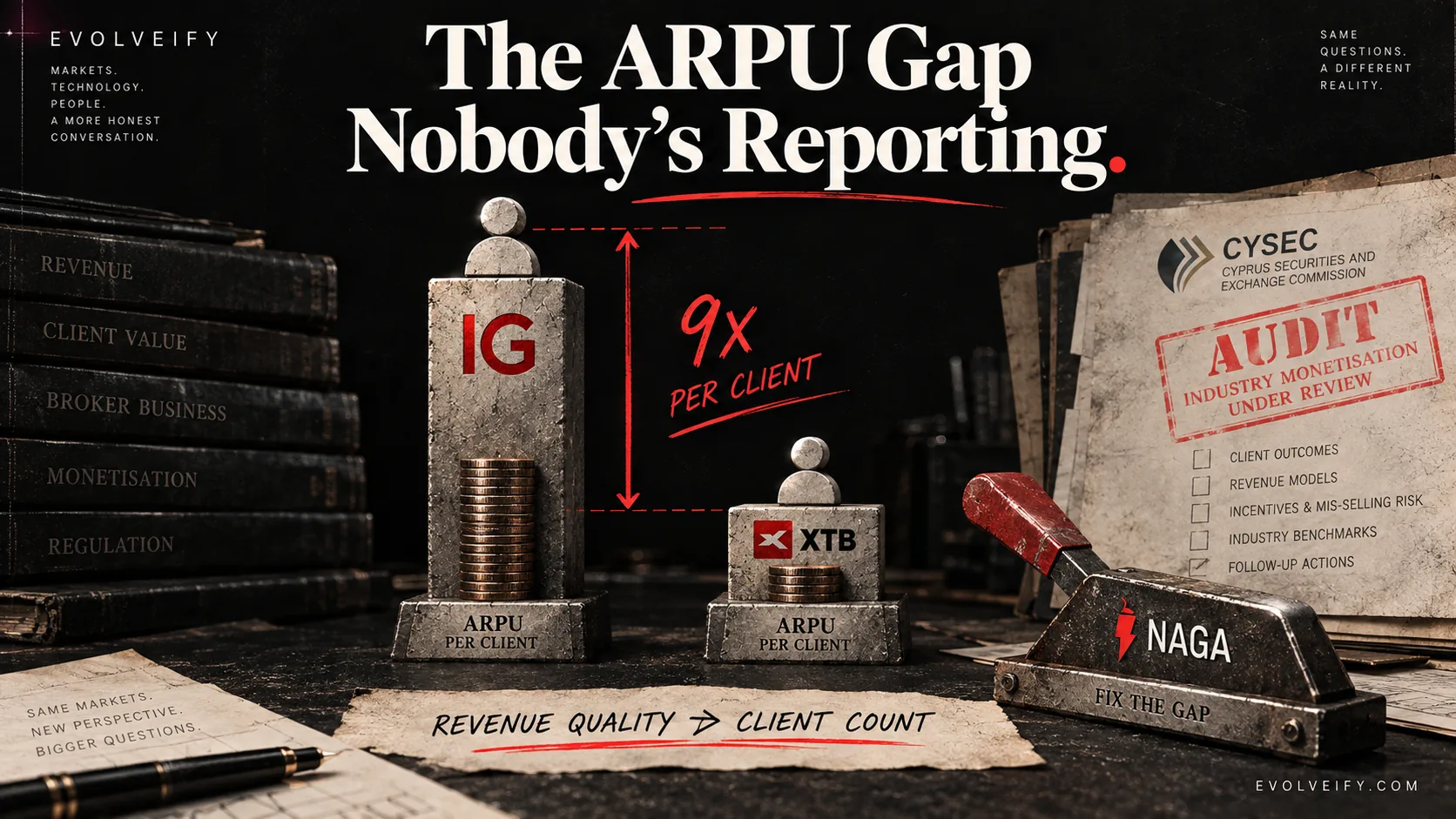
IG Group makes $3,240 off every client it acquires. Plus500 makes $2,310. CMC Markets makes $1,350. XTB makes $350.
Same industry. Same regulatory perimeter. A 9x gap in what a client is worth.
That's the number that mattered this week, buried in the Q2 earnings round from IG, CMC, Plus500 and XTB. Every one of them reported client numbers "surging." Every growth team on every earnings call talked about acquisition. Almost nobody talked about what happens after the click.
Here's my take: if your growth function is still reporting new accounts as the headline metric in 2026, you're reporting the wrong number. Four things back this up.
One, the ARPU spread above. XTB is out-acquiring almost everyone in the sector and monetizing worse than IG by an order of magnitude. That's not a product problem. That's an activation and retention problem dressed up as a growth win.
Two, CySEC just told you why. Its 2026 Common Supervisory Action is now running on-site inspections across CFD brokers, and the stated focus areas are staff compensation practices, digital platform design, and conflicts between a firm's revenue goals and client interests. Translation: regulators are auditing the exact mechanism growth teams have used for a decade — comp structures that reward volume of signups, not quality of clients. The gap between IG and XTB isn't an accident of scale. It's what happens when acquisition incentives run ahead of monetization discipline, and now Brussels is looking directly at the incentive structure, not just the outcome.
Three, look at where the smart money is actually moving. Plus500 didn't respond to a shrinking CFD margin by buying more traffic — it agreed to acquire Mehta Equities in India, buying its way into broking, futures and cash equities. eToro filed its F-1 for NASDAQ off the back of $824M revenue and $192M profit, not off account count. The operators playing the long game are diversifying revenue per client and proving profit quality to public markets, not flexing signup graphs in a press release.
Four, and this is the one I'd point to first: NAGA. First profitable half in the company's history. Net profit swung from -€2.6M to +€0.9M. EBITDA up 47% to €4.4M, margin up to 15.9% from 9.3%. And they got there by cutting marketing spend 25%, to €11.2M, while customer LTV rose 32% to €2,757 and CAC barely moved at €1,117. That's not a company that grew its way to profit. That's a company that spent less to acquire and got more out of every client it kept — the exact opposite of the XTB pattern above. Full credit where it's due: that's what disciplined growth actually looks like, and it's the model the rest of the sector should be studying instead of its own signup charts.
If you're an affiliate manager or acquisition lead reading your dashboard this week, the CPA you're optimizing against is a vanity number unless you know the LTV and ARPU it converts to six months out. A cheap client who churns in 60 days and never funds past minimum deposit costs you more than an expensive one who trades for years. XTB's own numbers prove the downside. NAGA's prove the fix.
Regulators are now auditing the comp plans that produced the XTB-style gap. Boards are now paying premiums for the brokers that closed it, and rewarding the ones that never let it open. The only people still celebrating raw signup growth are the ones who haven't checked their ARPU against IG's — or their LTV:CAC against NAGA's.
So the real question isn't how many clients you brought in this week. It's what each one is actually worth — and whether you'd want CySEC reading your answer.
Observed
What changed
G makes 9x what XTB makes per client. NAGA just proved the fix — and CySEC is now auditing why the rest of the industry hasn't.
Method
How this record was read
- Why now · editorial reading
- Filed 07 Aug 2026 · Signal desk · 4 min read. This is when the desk judged the move worth writing up — the dispatch body carries the reasoning.
- The tactic worth testing · editorial reading
- No tactic is claimed here unless the dispatch states one.
- Open question · editorial reading
- Does this hold as Signal distribution keeps moving, or is it specific to this cycle?