
Skip to content
Back to the ledger
Affiliate Economics03 JUN 20263 min readWATCHNeeds a call

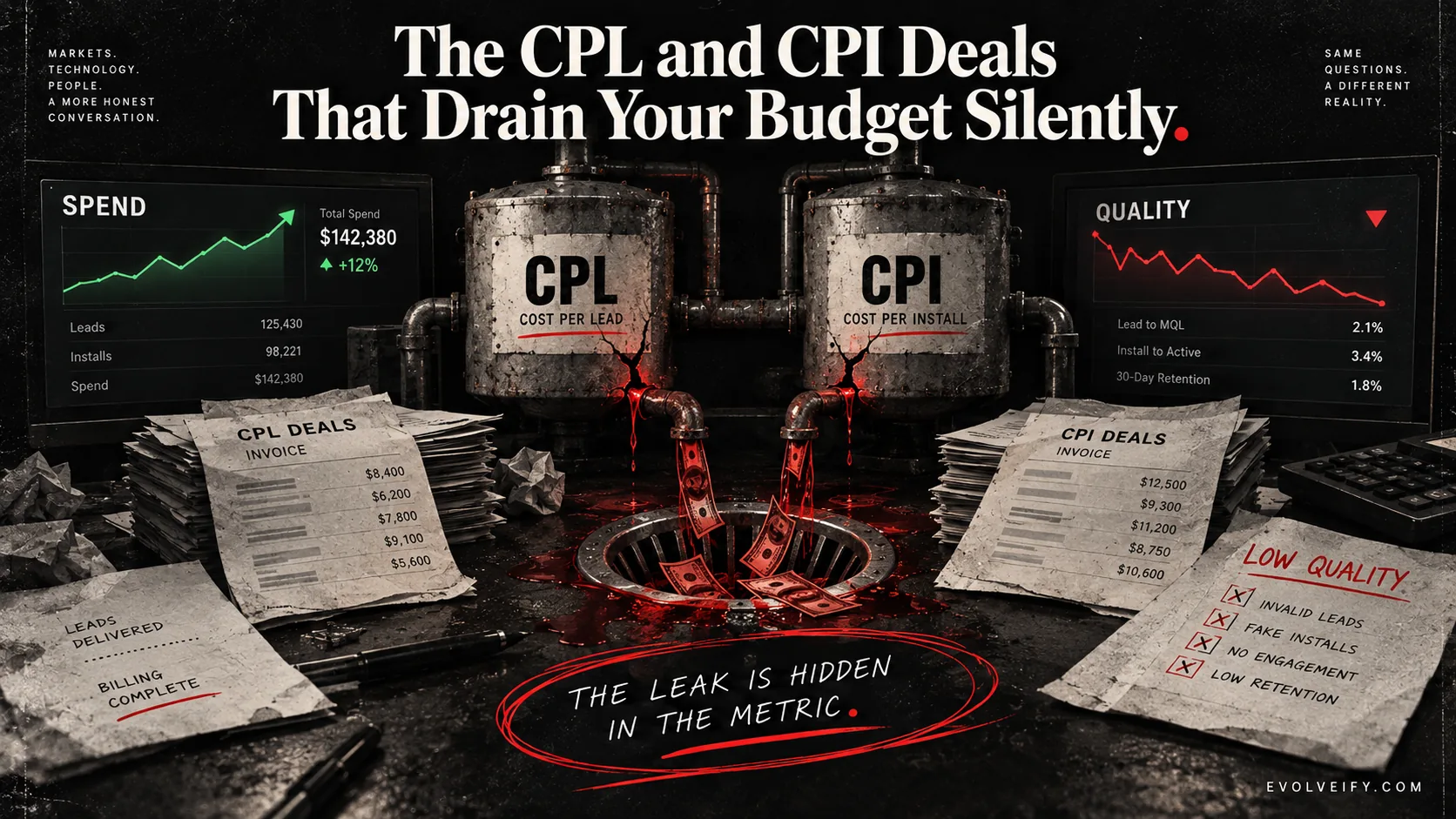
The CPL and CPI deals that drain your budget silently

The leads were real. The installs were real. You still got robbed.

Author observation — Evolveify original research.

The mechanismAuthor observation.

How a clean dashboard hides a bad source — plausible volume, post-invoice collapse, cohort analysis, contact and retention checks, and the renegotiation

  1. 01 · Delivery

    The volume looks valid

    400 leads in 72 hours. 2,000 installs in a week. Both dashboards clean, both invoices approvable on what's visible at the top of the funnel.

  2. 02 · Camouflage

    Built to pass basic validation

    No overnight spike — 35 to 50 leads a day at consistent timing, real contact details, enough behavioural variance to clear validation. On installs, generated behavioural sequences mimic onboarding so the tutorial runs and the first action fires.

  3. 03 · Collapse

    It shows up after the invoice

    Six weeks on, contact rate from that source is 1.4% against 19 to 22% for legitimate partners, and the clawback window has closed or was never written. Day 7 retention on the installs hits zero the moment the commission locks.

  4. 04 · Diagnosis

    Cohort by source, not cost per unit

    Pull lead-to-contact by source, and Day 7 and Day 30 retention by traffic source. As the record's examples: 18 to 35% Day 30 on funded accounts is normal, below 8% points at a device farm or undisclosed incentivised traffic. Check hourly distribution too — real traffic has variance.

  5. 05 · Move

    Renegotiate, pause, or cut — with the record

    Document the cohort evidence, then renegotiate, pause or cut the source, and close the contract gap. No lead-quality clawback and no post-install event requirement aren't oversights — the record calls them open invoices. The fraud doesn't beat detection; it waits for your payment terms.

Stated in the record as diagnostic examples — 35 to 50 leads per day drip pattern; 1.4% contact rate from the bad source versus 19 to 22% for legitimate partners; Day 30 retention of 18 to 35% on funded accounts, below 8% flagged.

How a clean-looking dashboard hides a bad traffic source, in five stages as the record describes them. First, the delivery looks valid: 400 leads in 72 hours from a CPL partner, 2,000 installs in a week from a CPI partner, both dashboards clean. Second, the pattern is built to avoid alerts: the record says modern CPL fraud no longer spikes overnight because that triggers alerts. Instead it sends 35 to 50 leads a day at consistent timing matching normal conversion windows, with real names, emails and phone numbers scraped or bought and submitted with enough behavioural variance to pass basic validation. On the install side, the numbers are real but the users are not — SDK spoofing and device-farm installs now use generated behavioural sequences that mimic onboarding, so the app opens, the tutorial runs and the first action fires, passing attribution fraud filters. Third, the collapse shows up after the invoice: six weeks later, contact rate from that source sits at 1.4 percent while legitimate partners run 19 to 22 percent, and the clawback window has closed or was never written into the deal. On installs, Day 7 retention goes to zero — no deposits, no second sessions, no engagement once the attribution window closed and the commission locked. Fourth, cohort and source analysis is what reveals it: pull lead-to-contact rate by source, and Day 7 and Day 30 retention by traffic source. The record's diagnostic examples, not universal rules — legitimate mobile partners in CFD and iGaming run 18 to 35 percent Day 30 retention on funded accounts, and below 8 percent points to a device farm or undisclosed incentivised traffic. It also suggests pulling the hourly distribution: natural affiliate traffic has variance, spiking on weekends and dipping midweek, while consistent daily drips at near-identical intervals are a signal rather than a coincidence. Fifth, the record's move: renegotiate, pause or cut the source with the evidence documented, and close the contract gap — no lead-quality clawback in a CPL deal and no post-install event requirement in a CPI deal are, in its words, open invoices waiting to be collected. Its closing line: the fraud does not beat your detection system, it waits for your payment terms.

Your CPL affiliate just delivered 400 leads in 72 hours. Your CPI partner hit 2,000 installs this week. Both dashboards look clean.

Check the contact rate on those leads. Check the Day 7 retention on those installs.

That's where the fraud lives now.

What CPL fraud looks like in 2026:

It doesn't spike overnight anymore. That used to work. Now it triggers alerts. So the modern CPL fraudster sends 35-50 leads per day, consistent timing, matching your normal conversion windows. Real names, real emails, real phone numbers. Scraped or bought from data brokers, then submitted through your form with enough behavioral fingerprint variance to pass basic validation.

Six weeks later your sales team's contact rate from that source is 1.4%. Every legitimate partner sits at 19-22%. You've already paid the invoice. The clawback window is closed or wasn't written into the deal at all.

You didn't buy leads. You bought a spreadsheet with good formatting.

What CPI fraud looks like in 2026:

The install numbers are real. The users aren't. SDK spoofing and device farm installs have been around for years, but the 2026 version is cleaner. AI-generated behavioral sequences now mimic genuine onboarding: the app opens, the tutorial runs, the first action fires. It passes Adjust and AppsFlyer's fraud filters because the behavior pattern looks human enough.

Then Day 7 retention hits zero. No deposits, no second sessions, no engagement of any kind. Just installs that evaporated the moment the attribution window closed and the commission was locked.

In regulated finance, a CPI deal with no deposit qualifier or FTD requirement downstream is not a performance deal. It's a flat fee with extra steps and a better story.

Three checks to run this week:

  1. CPL partners: pull lead-to-contact rate by source for the last 60 days. Any partner below 10% is a problem regardless of volume, tenure, or how good the relationship looks on paper.

  2. CPI partners: pull Day 7 and Day 30 retention by traffic source. Legitimate mobile partners in CFD and iGaming run 18-35% Day 30 retention on funded accounts. Below 8% and you're looking at a device farm or an incentivized traffic source that was never disclosed.

  3. Check delivery timing on both. Natural affiliate traffic has variance, spikes on weekends, dips midweek. Consistent daily drips at near-identical hourly intervals are a signal, not a coincidence. Pull the hourly distribution and look at it.

The trap:

You're optimizing for cost per lead and cost per install. The fraudster optimizes for exactly those same metrics. He wins every single time you forget to measure what happens after the conversion fires.

No lead quality clawback in your CPL deal. No post-install event requirement in your CPI deal. Those aren't oversights. They're open invoices waiting to be collected.

The fraud doesn't beat your detection system. It just waits for your payment terms.

What changed

The leads were real. The installs were real. You still got robbed.

How this record was read

Why now · editorial reading
Filed 03 Jun 2026 · Signal desk · 3 min read. This is when the desk judged the move worth writing up — the dispatch body carries the reasoning.
The tactic worth testing · editorial reading
No tactic is claimed here unless the dispatch states one. Take the situation to the Coach and test it against the archive.
Pressure-test this dispatch
Open question · editorial reading
Does this hold as Signal distribution keeps moving, or is it specific to this cycle?
Pressure-test this with Evolveify Coach
Share
XIN
Record details
Newsletter · Mon · Wed · Fri · 06:30 CET

Get the next dispatch on the wire.

Free. Unsubscribe from any issue in one click.

Free, three dispatches a week. We store your email to send the newsletter and nothing else — no selling, no ad lists. Unsubscribe from any issue in one click. Privacy.

// End dispatch · DSP/2026-06← Return to the ledgerView original ↗

You have read the argument. Now pressure-test your decision against it.

Coach will open with this dispatch as context: The CPL and CPI deals that drain your budget silently