
Skip to content
Back to the ledger
Fintech & Regulated Markets06 JUL 20263 min readCONFIRMED

The Hoodie Comes Off: How Europe Turned Perps Into CFDs Overnight

Perps didn't die in Europe — they just found out they had a dress code.

Proprietary desk research — evidence reviewed privately.

The mechanismAuthor observation.

How a perpetual became a CFD in Europe — definition, restriction, national classification, relocation, and the onshore alternative

  1. 01 · Definition

    A perpetual that meets the CFD definition is a CFD

    On February 24, ESMA said the label doesn't decide the category. A perpetual future meeting the CFD definition is a CFD, regardless of what it's called.

  2. 02 · Restriction

    MiFID II rules follow the classification

    That single line pulls the product under MiFID II: 2:1 retail leverage cap, negative balance protection, margin close-out, no bonuses.

  3. 03 · Classification

    CySEC names retail perps outright

    On June 10, CySEC told every firm it licenses — the largest concentration of CFD brokers in the EU, passporting into all 27 member states — that perpetual futures sold to retail clients are CFDs. The UK had already banned crypto derivatives for retail.

  4. 04 · Relocation

    The leverage leaves, sometimes behind the same badge

    The record's observation: firms didn't comply, they left. A 2:1 perp can't compete with a 100x perp, so higher-leverage activity moved to lighter jurisdictions — and dual-entity structures route a client who trusts the European badge to a group entity where the compensation fund doesn't exist.

  5. 05 · Onshore alternative

    A defined-risk venue now exists inside the rules

    An authorised, MiFID II-compliant venue runs perpetual-style products with defined risk, mandatory stops and no liquidation cascades, and CySEC expanded its own permissions in March to execute client orders directly. The demand doesn't disappear; the question is what the trader is standing on when the position turns.

Stated in the record — ESMA statement February 24; CySEC classification June 10; 2:1 retail leverage cap under MiFID II; perps cleared $86 trillion in volume last year.

The mechanism, in five stages. First, definition: on February 24, ESMA said a perpetual future that meets the CFD definition is a CFD, regardless of what it is called. Second, restriction: that classification drags the product under MiFID II, bringing a 2:1 retail leverage cap, negative balance protection, margin close-out and no bonuses. Third, national classification: on June 10, CySEC told every firm it licenses — the largest concentration of CFD brokers in the EU, passporting into all 27 member states — that perpetual futures sold to retail clients are CFDs, naming the product outright for the first time. The UK had already banned crypto derivatives for retail. Fourth, relocation: the record's observation is that firms did not comply, they left. A 2:1 perp cannot compete with a 100x perp, so higher-leverage activity moved to lighter jurisdictions, and the cleverest operators run two flags at once — the client sees the European badge and is routed to a group entity elsewhere, where the leverage is high and the compensation fund doesn't exist. Perps cleared $86 trillion in volume last year, so fines are a rounding error against that book. Fifth, the onshore alternative: an authorised, MiFID II-compliant venue now runs perpetual-style products with defined risk, mandatory stops and no liquidation cascades, and CySEC expanded its own permissions in March to execute client orders directly. The record's closing point is about what the trader is standing on when the position turns — a 2:1 floor and a compensation fund, or a flag nobody can find.

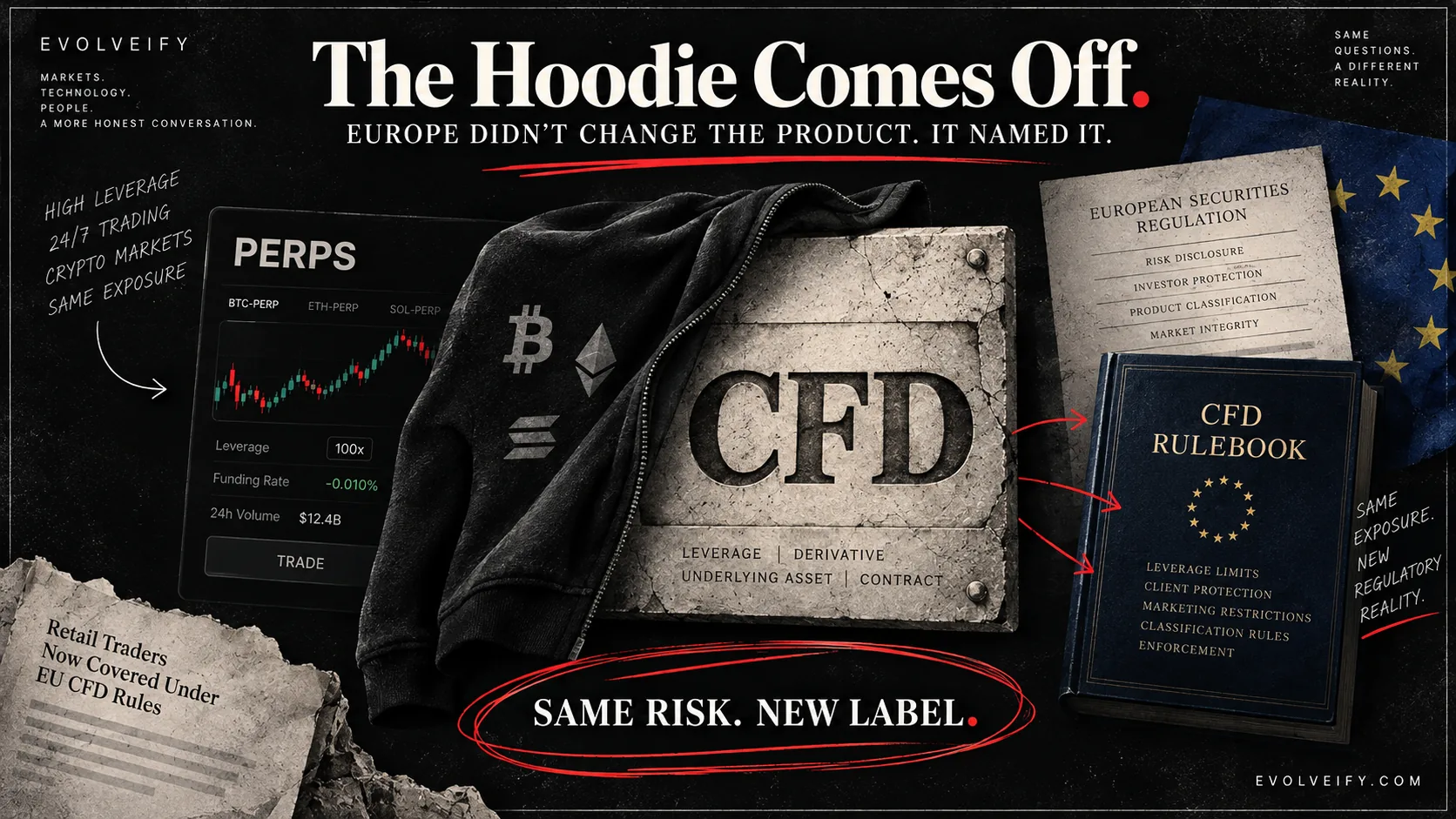
A perpetual future is a CFD in a hoodie. Same leverage, same liquidation at 3am, same rent money gone. For years the hoodie worked. Call it a perp instead of a CFD, book it in a jurisdiction nobody polices, and the rulebook governing every other leveraged retail product in Europe never touched you.

On February 24, ESMA took the hoodie off. A perpetual future that meets the CFD definition is a CFD, regardless of what you call it. That one line drags the hottest product in crypto under MiFID II: 2:1 leverage cap, negative balance protection, margin close-out, no bonuses.

Then CySEC moved. On June 10 it told every firm it licenses, the largest concentration of CFD brokers in the EU, the ones passporting into all 27 member states, that perpetual futures sold to retail clients are CFDs. Named outright, first time. The UK had already banned crypto derivatives for retail outright. When CySEC moves, the whole European market moves with it.

Here's the part that should worry every acquisition lead reading this. The firms didn't comply. They left. Perps cleared $86 trillion in volume last year, according to a16z, the most liquid product in crypto, almost none of it asking a European regulator for permission. A 2:1 perp can't compete with a 100x perp, so the leverage went where the leverage is legal. Seychelles first, $100-250K capital, a real Tier 4 license. Then Comoros, Mwali specifically, where MISA hands out a brokerage license on nominal capital, no office required, approved in weeks. One analysis calls MISA a registrar, not a regulator.

The cleverest operators run both flags at once. Client sees the CySEC badge, trusts it, then gets routed to the group's Mwali entity, where the perp runs at 100x and the compensation fund doesn't exist. CySEC issued the trust. The firm sold it and booked the risk somewhere the badge doesn't reach.

And the fines don't touch the math. Hyperliquid cleared $70 million in a single month last year. A settlement in the low hundreds of thousands is a rounding error against that book. Meanwhile the US just made enforcement weaker, scrapping gag rules on settlements and waving through Kalshi's Bitcoin perpetual contract a day after filing. Europe is pinning the perp down. Washington's handing it a podium.

What the cynics miss: CySEC didn't just ban, it built the alternative. Perpetuals.com is a CySEC-authorised, MiFID II-compliant venue running perpetual-style products with defined risk, mandatory stops, no liquidation cascades. CySEC expanded its own permissions in March to execute client orders directly. The onshore version now exists.

The perp isn't going away. The demand is real and the liquidity is real. The only question is what the trader is standing on when the position turns against them: a 2:1 floor and a compensation fund, or a flag on a map nobody can find.

CySEC built the floor. Ask the trader who got liquidated at 3am which side of it he wishes he'd been standing on.

What changed

Perps didn't die in Europe — they just found out they had a dress code.

How this record was read

Why now · editorial reading
Filed 06 Jul 2026 · CFD desk · 3 min read. This is when the desk judged the move worth writing up — the dispatch body carries the reasoning.
Evidence
2 external records sit under this dispatch.
View source trail →
The tactic worth testing · editorial reading
No tactic is claimed here unless the dispatch states one. Take the situation to the Coach and test it against the archive.
Pressure-test this dispatch
Open question · editorial reading
Does this hold as CFD distribution keeps moving, or is it specific to this cycle?
Pressure-test this with Evolveify Coach
Share
XIN
Record details
Newsletter · Mon · Wed · Fri · 06:30 CET

Get the next dispatch on the wire.

Free. Unsubscribe from any issue in one click.

Free, three dispatches a week. We store your email to send the newsletter and nothing else — no selling, no ad lists. Unsubscribe from any issue in one click. Privacy.

// End dispatch · DSP/2026-07← Return to the ledgerView original ↗

You have read the argument. Now pressure-test your decision against it.

Coach will open with this dispatch as context: The Hoodie Comes Off: How Europe Turned Perps Into CFDs Overnight