
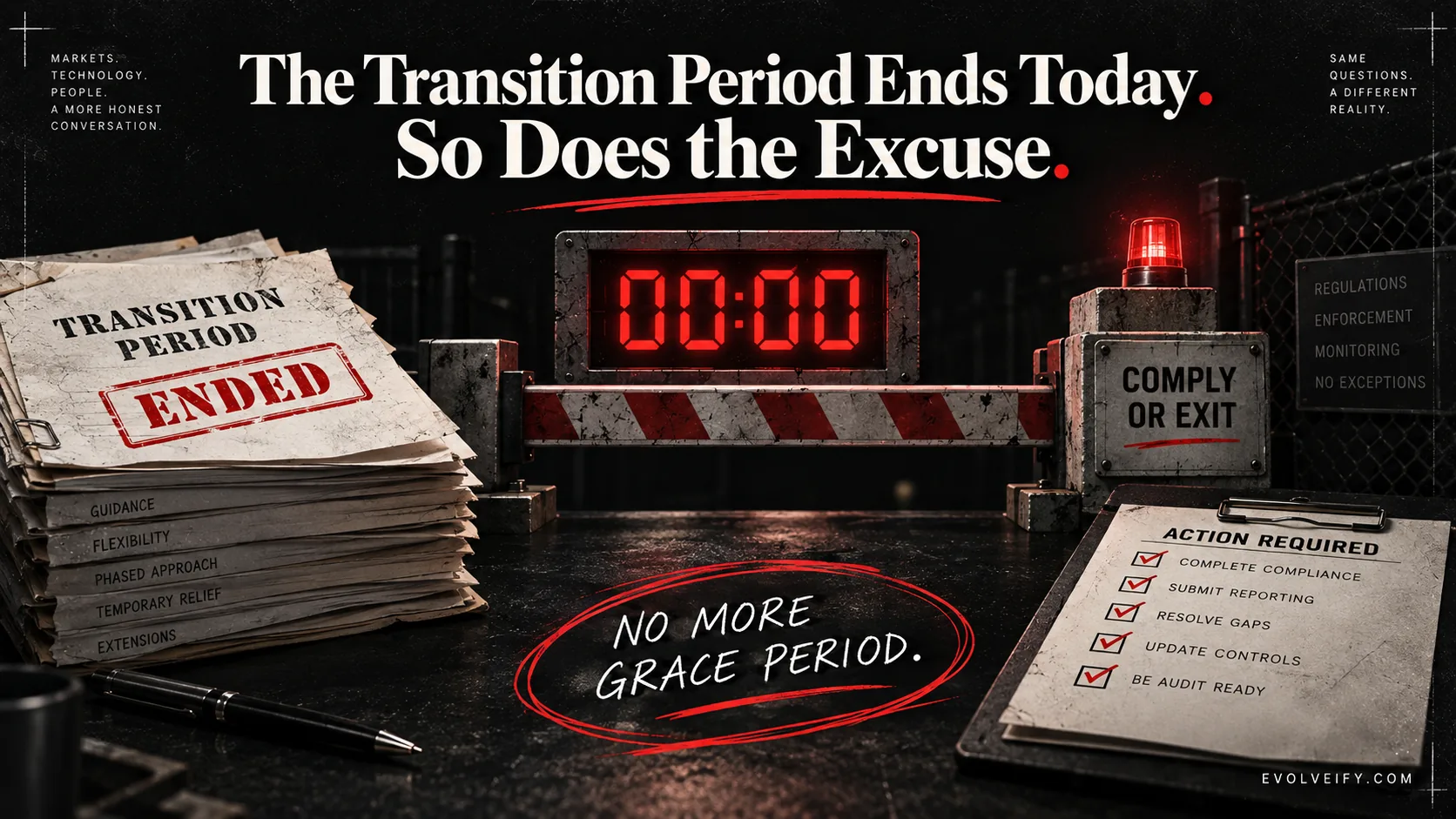
MiCA's transitional period, the grace window that let crypto asset service providers keep serving EU clients under their old national licenses while they queued for real authorization, closes today, July 1. Not "closes soon." Not "closes this quarter." Today. Any CASP still leaning on transitional cover as of this morning is, as of this morning, operating outside EU law. Delistings, disabled features, frozen deposits, a withdrawal window if they're lucky. That's not the penalty phase. That's just what happens automatically when the legal basis for the relationship disappears.
If you've built acquisition into that world (affiliate funnels, comparison sites, paid distribution pointed at exchanges and platforms) you've spent three years routing traffic at rails that were provisionally legal. As of today, some of them aren't rails anymore. They're liabilities with a login page.
That part's the news. Here's the pattern underneath it, and it's the part that should actually change what you do this quarter.
MiCA didn't invent the idea that distribution needs its own license. It just gave it a hard deadline. Look at what ASIC has been saying in its own updates this year, alongside the FCA, the Canadian regulators, Hong Kong's SFC, and CONSOB: an affiliate program that pays on conversion isn't automatically a marketing arrangement anymore. Depending on how it's structured, it can be the regulated financial service, meaning the affiliate needs a license the way the principal firm does, not a disclosure banner and a hope.
Three different regulatory regimes, three different mechanisms. MiCA's authorization deadline, ASIC's classification of affiliate arrangements that pay on conversion, the FCA's "you're responsible for what you caused to be made" doctrine. And they're all converging on the same conclusion from different directions: the growth layer doesn't get to be the unregulated part of the business anymore. It used to be the compliance team's job to keep the product clean and everyone else's job to sell it however sold best. That division is the thing being legislated out of existence, jurisdiction by jurisdiction, deadline by deadline.
What actually happens next. Three predictions.
The acquisition channels built on ambiguity get more expensive first, then disappear. Every funnel that worked becausenobody had fully worked out whose license covered it is now sitting on borrowed time. Some of that traffic just stops converting the moment the destination goes dark. Some of it gets rerouted to whatever's left standing, which is a smaller, pricier set of properly authorized platforms with none of the margin the grey market ones offered.
Your affiliate agreements stop being marketing paperwork and start being risk documents. The firms that treated affiliate contracts as a formality (flat fee, loose scope, "post what converts") are the ones with the most exposure right now, because a contract that doesn't specify licensing status, content control, and audit rights doesn't protect you from a regulator asking who's responsible for a conversion paid promo that turned out to need its own license.
The operators who get ahead of this stop thinking of "compliance" and "growth" as two departments. The MiCA deadline was on the calendar for three years. The finfluencer classification shift has been telegraphed since the first coordinated week of action. Nobody who got caught by either one this week can say there was no warning, which means the firms still exposed aren't unlucky. They're the ones who kept growth and legal in separate meetings.
So what do you actually do with this before the next deadline lands on a Wednesday you didn't see coming?
Pull the list of every platform, exchange, and affiliate arrangement your acquisition depends on and check authorization status today, not this quarter. "Probably fine" isn't a compliance position anymore. It's a documented decision someone will have to defend. Rewrite the affiliate agreements that are still running on a handshake so they specify who's licensed for what, because the contract is now the thing standing between a normal conversion and an unlicensed financial service. And put growth and compliance in the same room permanently, not on an as needed basis, because the firms getting hit this year aren't the ones with worse products. They're the ones who found out about the deadline from a headline instead of from each other.
MiCA didn't sneak up on anyone. Neither did any of this. The only real question left is whether "we didn't know" or "we didn't ask" is going to be your answer when someone finally does.
See you Friday.
Observed
What changed
Somewhere in Brussels, a clock that's been running since 2023 hit zero this morning.
Method
How this record was read
- Why now · editorial reading
- Filed 01 Jul 2026 · Signal desk · 4 min read. This is when the desk judged the move worth writing up — the dispatch body carries the reasoning.
- The tactic worth testing · editorial reading
- No tactic is claimed here unless the dispatch states one.
- Open question · editorial reading
- Does this hold as Signal distribution keeps moving, or is it specific to this cycle?