
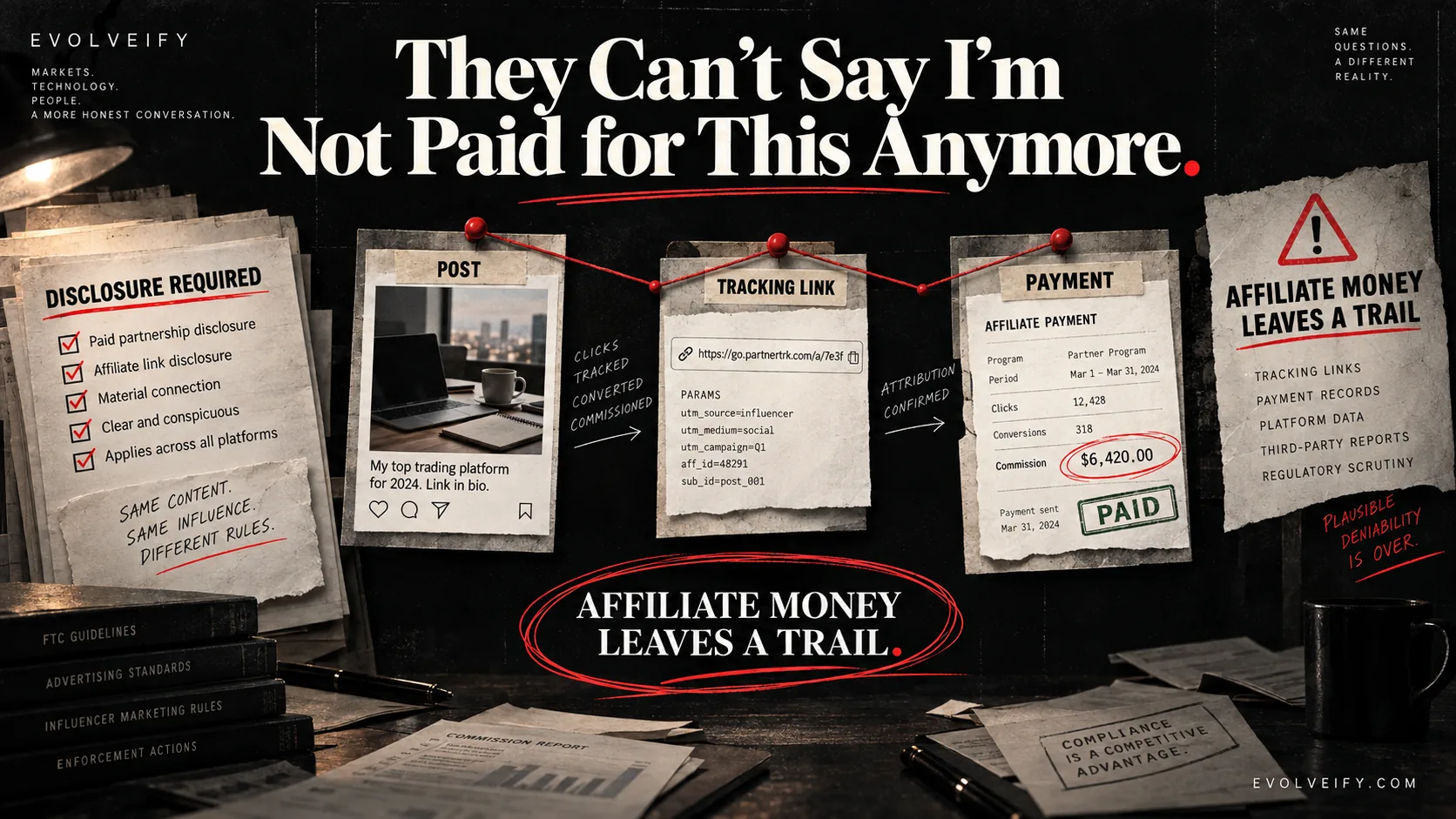
The whole trick was deniability.
A creator opens a trading app on camera, talks about how easy it is, drops a link, and tells you — straight to the lens — "I'm not getting paid for this, I just genuinely use it." Soft eyes. Casual tone. The single most valuable sentence in financial marketing, because it converts a paid endorsement into what feels like a friend's recommendation. Trust at a discount.
RIS just made that sentence a lie you can be punished for.
Under the new rules, any marketing communication has to be clearly identifiable as marketing. And wherever a finfluencer is remunerated to push a product, that has to be prominently stated. Not buried in a description. Not a greyed-out #ad three hashtags deep. Prominent. The video that says "I'm not paid for this" while the creator is, in fact, paid for this is no longer a grey area — it's the exact behaviour the regulation exists to kill.
Disclosure is the easy part. The content rules are the ones that bite.
Strip away the "is it labelled" question and look at what a financial promo now has to actually contain. Fair, clear, not misleading. Risks and benefits presented in a balanced way. Key product characteristics — including the risk of loss — on the face of the content.
Sit with that for a second against the format. The entire finfluencer playbook is one-sided by design: the win, the lifestyle, the screenshot of the green day, the "link in bio." Balance is not a stylistic choice the format can absorb. A sixty-second hype clip that now has to give equal airtime to "you can lose your money" isn't a hype clip anymore. The rule doesn't just unmask the ad. It defuses the thing that made the ad work.
And here's the part the creators haven't fully priced in: it isn't their problem to solve. It's yours.
RIS doesn't chase the influencer. It chases the firm that hired them. If you use a creator to promote your products, you need a written agreement with them, their details on file, documented control over what they post, and an archive of all of it for the life of the client relationship. When a creator runs a non-compliant promo, the regulator doesn't knock on the creator's door. It knocks on yours — the licensed entity, the one with something to lose.
So the comfortable arrangement that powered half the acquisition in this industry — pay a creator, let them "organically" rave, keep the relationship loose and deniable so nobody's exposed — is now the single riskiest line item in your funnel. Loose and deniable was the feature. RIS turns it into the liability.
What actually happens next — three predictions.
The cheap end of your roster disappears. The micro-creators doing twelve undisclosed promos a week for flat fees can't survive a regime that demands contracts, balanced risk content, and labelling that tanks their conversion. They won't comply. They'll quietly stop taking finance money, or they'll keep going until an ESMA-named firm gets made an example of. Either way, that channel thins out fast — and the volume you used to buy there has to go somewhere.
The survivors get more expensive and more professional. The creators who do adapt — real disclosure, balanced content, contracts they'll actually sign — become a managed, documented, archived partner set. Fewer of them, costing more, looking a lot more like a regulated marketing supplier than a guy with a ring light. That's not a loss. For an operator who consolidates early, that's a moat: compliant distribution your sloppier competitors can't legally replicate.
"I'm not paid for this" stops converting — even when it's allowed. Here's the quiet second-order effect. Once audiences spend a year watching every financial creator slap a prominent paid-partnership label on their content, the few who still claim independence get more scrutiny, not less. The label becomes the norm, and the unlabeled claim starts reading as either a relic or a red flag. The trust discount RIS targets doesn't just get regulated away. It gets culturally repriced.
So what do you do with this before end-2028 stops being far away?
Audit your creator relationships now, not in 2027 — anything running on a handshake and plausible deniability is a liability you're currently carrying unhedged. Move your best partners onto real agreements with disclosure and content standards baked in, and treat that paperwork as a competitive asset rather than a compliance chore. And rebuild your creative assumption: stop buying the illusion of independence, because it's the one thing the new rules are specifically designed to destroy, and start buying disclosed, balanced, durable distribution that survives a regulator reading the transcript.
The finfluencer era didn't sell products. It sold the feeling that nobody was selling you anything. RIS just made that feeling say its real name out loud.
When every promo has to admit it's a promo, what's left of an influence built on pretending it wasn't?
See you Wednesday.
Observed
What changed
Mandatory ad labels, balanced-risk rules, and the liability lands on you, not the creator.
Method
How this record was read
- Why now · editorial reading
- Filed 29 Jun 2026 · Signal desk · 5 min read. This is when the desk judged the move worth writing up — the dispatch body carries the reasoning.
- The tactic worth testing · editorial reading
- No tactic is claimed here unless the dispatch states one.
- Open question · editorial reading
- Does this hold as Signal distribution keeps moving, or is it specific to this cycle?