
Skip to content
Back to the ledger
AI & Discovery29 MAY 20263 min readWATCHNeeds a call

You're Automating the Wrong 20%

Every affiliate manager I know is using AI. Almost none of them are using it on the part that actually matters.

Author observation — Evolveify original research.

The comparisonAuthor observation.

The wrong 20% to automate versus the work that actually decides the programme — compared by task type, failure mode, and operator response

  • 01 · Task type

    What the work actually is

    What most programmes automate

    Reporting. Performance summaries, affiliate newsletters, templated partnership emails — the part of the job that was already fast, already low-stakes, already handled by a cheap tool years ago.

    The 20% that decides the outcome

    Recruitment quality, fraud surface, partner LTV segmentation. Scoring partners on vertical fit, deposit quality and traffic mix; catching self-tagging, bonus arbitrage and multi-account clusters; separating retained depositors from day-30 churn.

  • 02 · Failure mode

    How each one breaks

    What most programmes automate

    You automated the output, not the thinking. Summaries nobody reads, newsletters nobody opens, outreach converting at the same 1.2 percent because the targeting logic behind it never changed.

    The 20% that decides the outcome

    Judgment stays manual and late — recruitment decided at a conference three weeks after you should have acted. Fraud reviewed by humans is too slow and too polite: the payout has cleared two cycles before the pattern is visible.

  • 03 · Response

    What the operator does about it

    What most programmes automate

    Nothing changes. The record notes one 2026 operator panel finding 67 percent of programmes will run at least one AI-driven workflow by Q4 — with nobody asking which workflow it is.

    The 20% that decides the outcome

    Point the judgment work at AI-assisted scoring, pattern detection and cohort analysis by source and geography. The record's test: if it's recruitment and fraud, the programme looks completely different in twelve months.

Stated in the record — undetected affiliate fraud estimated at 15 to 30 percent of affiliate cost; templated outreach converting at 1.2 percent; one 2026 operator panel finding 67 percent of programmes with at least one AI-driven workflow by Q4.

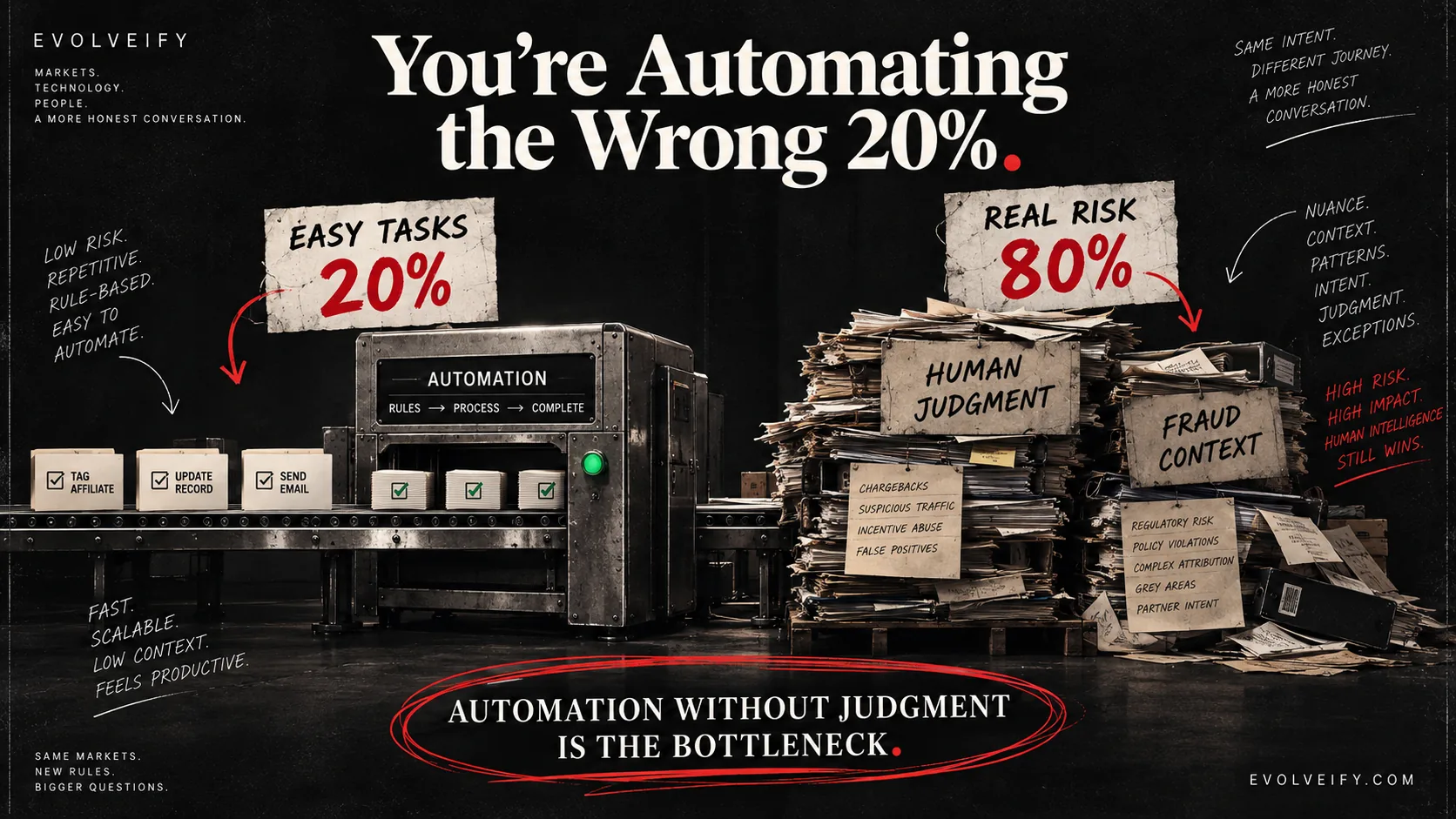
The record compares two uses of AI inside an affiliate programme, arguing that most teams automated the wrong fifth of the job. On task type: most programmes point AI at reporting — performance summaries, affiliate newsletters, templated partnership emails. The record's objection is that this was already the fast, low-stakes part of the job, something a cheap tool handled years ago. The work that determines whether the programme grows or bleeds is recruitment quality, fraud surface, and partner LTV segmentation: scoring affiliates by vertical fit, deposit quality on comparable programmes and traffic-source mix; pattern detection across self-tagging, bonus arbitrage networks and multi-account clustering; and cohort analysis separating retained depositors from first-deposit tourists who churn by day thirty. On failure mode: automating output leaves the thinking unchanged — summaries nobody reads, newsletters nobody opens, and outreach converting at the same rate as before because the targeting logic behind it never changed. On the other side, the failures are expensive and slow to surface. Recruitment is still done manually, at a conference, over a drink, three weeks after the moment to act. Fraud detection at human speed is too slow and too polite: by the time a pattern is visible to someone reading reports manually, the payout has cleared two cycles, and the record puts undetected affiliate fraud somewhere between fifteen and thirty percent of affiliate cost depending on who is asked. Without cohort analysis by source and geography, a programme has a blended average that flatters everyone and explains nothing. On operator response: the record's read is that the tool changed while the logic behind it did not, and it cites one 2026 operator panel finding that sixty-seven percent of programmes will have at least one AI-driven workflow by the fourth quarter — without asking which workflow. Its closing test is direct: if the workflow is reporting, nothing changes; if it is recruitment and fraud, the programme looks completely different in twelve months.

Most affiliate managers using AI are automating reporting.

Wrong move.

You took the part of the job that was already fast, already low-stakes, already something a $12/month tool could handle in 2019. And you gave it to AI. Then you went to lunch.

Meanwhile the part that actually determines whether your program grows or bleeds is still being done manually. At a conference. Over a drink. Three weeks after you should have acted.

Here’s what the 20% that matters actually looks like.

Recruitment. Not “send 40 emails from a template.” Scoring affiliates by vertical fit, deposit quality on comparable programs, traffic source mix, and whether they’re actually acquiring your ICP or just sending volume. That takes judgment. AI has judgment now. Most programs are still using a spreadsheet and a LinkedIn search, which is how they recruited in 2017 and how they’re recruiting today. The tool changed. The logic behind it didn’t.

Fraud detection. The industry average for undetected affiliate fraud sits somewhere between 15 and 30% of affiliate cost depending on who you ask and how honest they’re willing to be. The pattern detection that catches self-tagging, bonus arbitrage networks, and multi-account clustering is not a human job. It never was. Humans are too slow and too polite to catch it in time. By the time a fraud pattern is visible to someone manually reviewing reports, the payout has already cleared two cycles.

Partner quality segmentation. Which partners in your top 20 are genuinely bringing retained depositors versus which ones are sending you first-deposit tourists who churn by day 30. The RevShare math on those two groups is completely different. If you’re not running AI-assisted cohort analysis on partner traffic by source and GEO, you don’t actually know which group you have. You have a blended average that flatters everyone and explains nothing.

That’s the 20%. Recruitment quality, fraud surface, partner LTV segmentation.

Instead most programs are using AI to generate performance summaries nobody reads, produce affiliate newsletters nobody opens, and draft “partnership opportunity” emails that convert at the same 1.2% they always did because the targeting logic behind them hasn’t changed. You automated the output. The thinking is the same.

Track360’s 2026 operator panel found 67% of programs will have at least one AI-driven workflow by Q4. What they didn’t ask: which workflow.

If it’s reporting, nothing changes. If it’s recruitment and fraud, your program looks completely different in 12 months.

The question isn’t whether your affiliate team is using AI. It’s whether they’re using it where the money actually is. And if you have to think about the answer, you already know it.

What changed

Every affiliate manager I know is using AI. Almost none of them are using it on the part that actually matters.

How this record was read

Why now · editorial reading
Filed 29 May 2026 · AI Traffic desk · 3 min read. This is when the desk judged the move worth writing up — the dispatch body carries the reasoning.
The tactic worth testing · editorial reading
No tactic is claimed here unless the dispatch states one. Take the situation to the Coach and test it against the archive.
Pressure-test this dispatch
Open question · editorial reading
Does this hold as AI Traffic distribution keeps moving, or is it specific to this cycle?
Pressure-test this with Evolveify Coach
Share
XIN
Record details
Newsletter · Mon · Wed · Fri · 06:30 CET

Get the next dispatch on the wire.

Free. Unsubscribe from any issue in one click.

Free, three dispatches a week. We store your email to send the newsletter and nothing else — no selling, no ad lists. Unsubscribe from any issue in one click. Privacy.

// End dispatch · DSP/2026-05← Return to the ledgerView original ↗

You have read the argument. Now pressure-test your decision against it.

Coach will open with this dispatch as context: You're Automating the Wrong 20%